

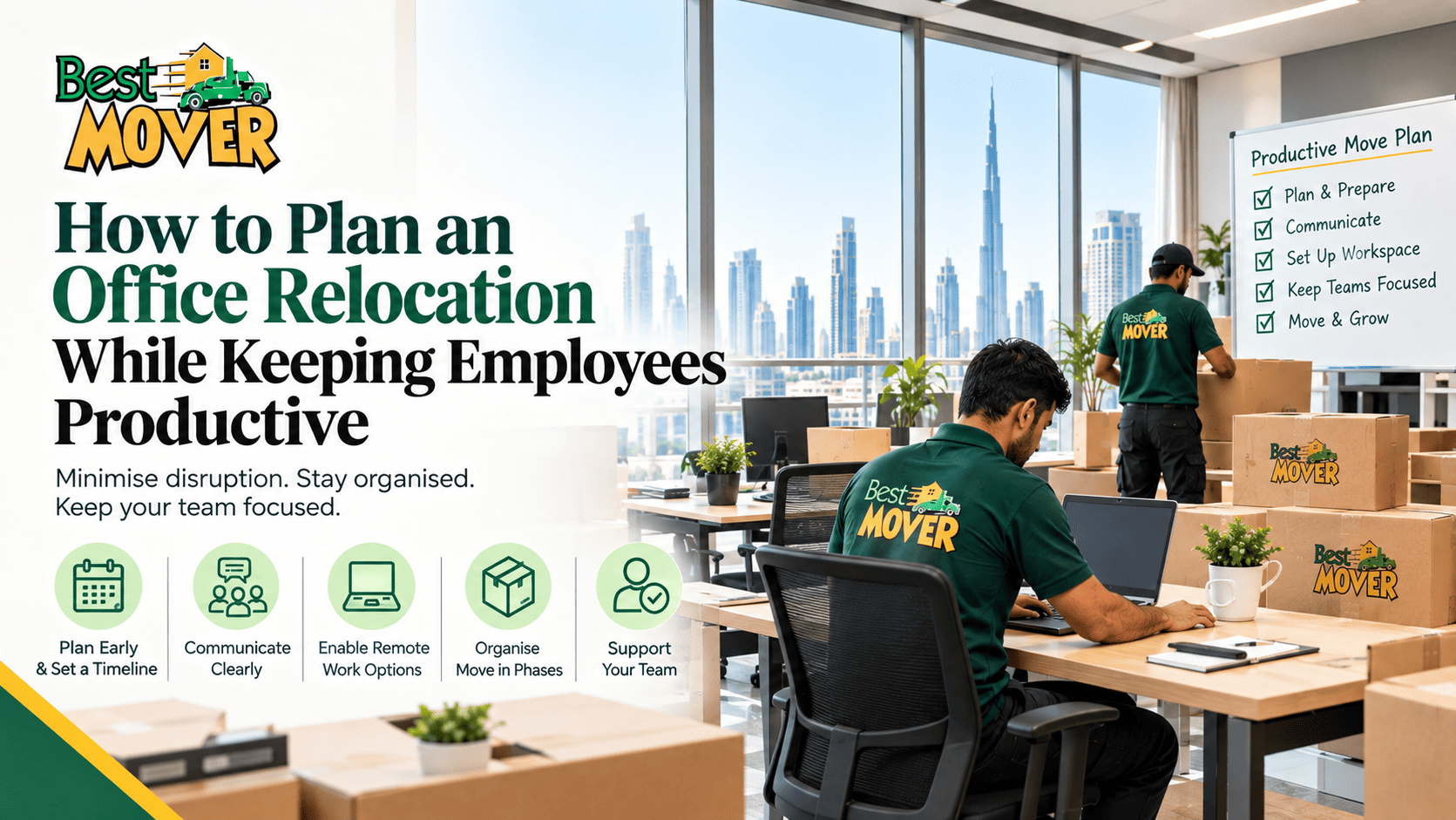
An office move can be exciting for a growing business, but it can also create a temporary productivity problem.
Employees still have deadlines to meet, customers to support and projects to complete while furniture is being packed, computers are being disconnected and the new workplace is being prepared.
The goal of good office relocation planning is therefore not simply to move everything from one address to another. It is to make the transition with as little interruption to normal business operations as possible.
With the right planning, communication and support from experienced Office Movers, businesses can organise an office move without disruption and give employees a clear plan for what happens before, during and after relocation.
Why Office Relocation Can Affect Productivity
An office move can interrupt productivity in several ways.
Employees may lose access to:
- Computers
- Internet connections
- Printers
- Important documents
- Meeting rooms
- Office equipment
- Workstations
There can also be confusion about where employees should work, when they should return and where their equipment has been moved.
For some businesses, even one day of significant downtime can affect customers and revenue.
That is why business relocation planning in Dubai should include employee productivity as one of its main priorities.
Start Office Relocation Planning Early
The earlier you begin, the more options you have.
For a straightforward office move, begin planning several weeks before the intended moving date. Larger offices may require considerably more preparation.
Start by confirming:
- New office availability
- Lease dates
- Moving date
- Building requirements
- IT installation schedule
- Furniture requirements
- Employee communication
- Moving company
- Business continuity arrangements
Avoid treating the relocation as something that only begins when the packing boxes arrive.
A successful move is usually the result of preparation carried out well in advance.
1. Appoint an Office Move Coordinator
Give one person responsibility for coordinating the relocation.
This person can act as the central point of contact between:
- Management
- Employees
- HR
- IT
- Building management
- Furniture suppliers
- Moving company
For a larger company, create a small relocation team with representatives from different departments.
This avoids a common problem: everyone assumes someone else is handling an important task.
2. Create a Clear Moving Timeline
Employees should know what is happening and when.
Create a simple timeline covering:
Before the Move
- Packing dates
- Employee instructions
- Equipment preparation
- IT planning
Moving Day
- Office closure or remote-working arrangements
- Loading schedule
- Transportation
- New-office setup
After the Move
- IT testing
- Workstation setup
- Employee return
- Final checks
A visible timeline helps employees plan their own work around the relocation.
3. Communicate With Employees Early
Do not surprise employees with moving instructions a few days before relocation.
Tell them early:
- Why the company is moving
- When the move will happen
- Where the new office is located
- What they need to pack
- What they should take home
- When they can access the new workplace
- Whether remote working will be available
Employees are much more likely to cooperate when they understand the plan.
Good communication also reduces repetitive questions for management and HR.
4. Let Employees Prepare Their Personal Desk Items
Employees can usually handle their own personal belongings and non-essential desk items.
Ask them to:
- Remove personal possessions
- Take home unnecessary items
- Clear drawers
- Organise paperwork
- Label their workstation
- Follow company instructions for equipment
Professional movers can then focus on the larger physical relocation.
This creates a clear division of responsibility between employees and the moving team.
5. Create a Detailed Office Inventory
Before packing begins, identify what is moving.
Your inventory can include:
Workstations
- Desks
- Chairs
- Cabinets
- Shelving
Technology
- Computers
- Monitors
- Printers
- Servers
- Networking equipment
Shared Areas
- Conference tables
- Reception furniture
- Meeting-room equipment
- Pantry appliances
Documents and Supplies
- Files
- Stationery
- Marketing materials
- Storage items
An inventory makes it easier to determine the moving requirements and identify missing items after the relocation.
6. Plan the IT Move Separately
For most modern businesses, this is one of the most important steps.
Employees cannot be productive if they arrive at the new office and discover that computers or internet connections are not working.
Coordinate the relocation of:
- Computers
- Servers
- Network equipment
- Printers
- Telephones
- Wi-Fi infrastructure
- Cables
- Other critical technology
Back up important data before equipment is disconnected.
If your business uses specialist IT support, coordinate their schedule with the moving company so that technology can be restored as soon as practical.
7. Consider a Phased Office Move
A business does not always have to move everything at once.
If your company needs to remain operational, consider dividing the relocation into phases.
For example:
Phase 1: Storage and non-essential items
Phase 2: Furniture and general equipment
Phase 3: Department-by-department relocation
Phase 4: IT and essential equipment
Phase 5: Final setup and testing
A phased approach can be particularly useful for larger businesses where completely stopping operations is not practical.
8. Use Remote Working Strategically
If your company allows employees to work remotely, use it as part of the relocation plan.
For example, employees could work remotely while:
- Desks are dismantled
- Computers are being moved
- The old office is being cleared
- New workstations are being installed
However, remote working should be organised rather than improvised.
Confirm:
- Which employees will work remotely
- For how long
- How they will access company systems
- How meetings will be handled
- Who needs to remain available onsite
This can turn a potentially disruptive moving day into a normal working day for many employees.
9. Move Outside Peak Working Hours
Depending on the business and building rules, evenings or weekends may be useful for physical relocation.
Moving outside normal working hours can allow employees to finish their workday at the old office and return to a more organised workspace afterward.
Before choosing this option, confirm that:
- The building permits after-hours access
- Security arrangements are available
- Your moving company can accommodate the schedule
- IT support is available when needed
The best schedule depends on your business operations.
10. Prepare the New Office Before Employees Arrive
Do not bring employees into an unfinished workspace if it can be avoided.
Before the first working day, check:
- Electricity
- Internet
- Air conditioning
- Lighting
- Access cards
- Workstations
- Meeting rooms
- Printers
- Pantry facilities
- Restrooms
Ideally, employees should arrive to a workplace where the essentials are already functional.
This is one of the most effective ways to support an office move without disruption.
11. Label Every Workstation
A simple labelling system can save considerable time.
For example:
HR – Desk 01
Sales – Desk 05
Accounts – Desk 03
Meeting Room – Equipment
Reception – Furniture
The same labels should correspond with your office layout.
When movers unload furniture, they can place items where they belong instead of creating a large pile that employees have to sort through later.
12. Protect Business-Critical Documents
Not every box has the same priority.
Identify documents and materials that employees may need immediately after the move.
Keep these clearly labelled and easily accessible.
Important records should also be handled according to your company’s confidentiality and security procedures.
A well-organised document move prevents employees from spending valuable working hours searching through unidentified boxes.
13. Create an “Open First” Area
Consider preparing a small group of boxes containing items the office will need immediately.
This could include:
- Stationery
- Chargers
- Extension cables
- Basic tools
- Printer supplies
- Cleaning materials
- Important documents
- Labels and tape
Clearly mark these boxes OPEN FIRST.
This is a small step, but it can make the first few hours in the new office much easier.
14. Coordinate With Building Management
Building requirements can affect your schedule more than expected.
Before moving day, confirm:
- Loading area availability
- Service elevator access
- Parking
- Moving hours
- Security procedures
- Vehicle access
- Access cards
Share this information with your moving company.
A truck arriving at a building without the correct access arrangement can create delays that affect the entire relocation schedule.
15. Choose Office Movers Who Understand Business Requirements
The moving company should understand that an office relocation is a business project, not simply a transportation job.
When comparing Office Movers, ask about:
- Commercial relocation experience
- Packing services
- Furniture dismantling
- Reassembly
- Equipment handling
- After-hours moving
- Vehicle requirements
- Building coordination
The moving team should be able to work according to your schedule and understand which parts of the move are most important to your business.
A Practical Office Relocation Timeline
4–8 Weeks Before
☐ Confirm the new office
☐ Set the moving date
☐ Appoint a relocation coordinator
☐ Choose your moving company
☐ Start the inventory
☐ Begin employee communication
2–4 Weeks Before
☐ Finalise furniture requirements
☐ Plan IT relocation
☐ Declutter
☐ Confirm building requirements
☐ Arrange internet and utilities
☐ Decide on remote-working arrangements
1 Week Before
☐ Pack non-essential items
☐ Label workstations
☐ Back up important data
☐ Confirm the moving sequence
☐ Confirm loading and parking arrangements
1–2 Days Before
☐ Complete packing
☐ Secure important documents
☐ Prepare essential office supplies
☐ Confirm IT support
☐ Reconfirm the moving schedule
Moving Day
☐ Complete a final office inspection
☐ Supervise loading
☐ Keep critical items clearly identified
☐ Coordinate transportation
☐ Check the new office before employees arrive
First Day at the New Office
☐ Test internet and IT systems
☐ Check workstations
☐ Confirm essential equipment
☐ Help employees locate their desks
☐ Resolve missing or misplaced items
Common Productivity Mistakes During an Office Move
Moving Without a Communication Plan
Employees become uncertain about where they should work and what they need to do.
Solution: Give employees clear instructions and dates in advance.
Forgetting IT Dependencies
Furniture may arrive perfectly, but employees cannot work because the network is unavailable.
Solution: Coordinate IT separately and test critical systems before employees return.
Packing Everything Together
Unlabelled boxes create hours of unnecessary searching.
Solution: Label boxes by department, room and priority.
Moving During Core Working Hours
Physical relocation can create noise, restricted access and interruptions.
Solution: Consider evenings, weekends or phased relocation where practical.
Choosing Movers Based Only on Price
A low quotation may not provide the level of coordination required for a business move.
Solution: Compare experience, service scope, handling and scheduling—not just price.
Why Choose Best Mover for Office Relocation in Dubai?
Best Mover has more than 15 years of experience and is known for professional handling and utmost care.
Office relocation requires coordination between the business, employees, building management and moving team. Furniture, equipment and documents need to reach the new location in an organised manner so employees can get back to work as quickly as practical.
With experience in office shifting, Best Mover focuses on the practical requirements of commercial relocation and helps businesses plan the physical move around their operational needs.
For companies searching for dependable Office Movers in Dubai, the objective should be more than simply finding a truck. Choose a moving partner that understands schedules, workplace equipment, furniture handling and the importance of minimising business disruption.
Final Thoughts
A successful office relocation is measured by more than whether everything arrives at the new address.
The real test is whether employees can return to work without unnecessary confusion, downtime or disruption.
Effective office relocation planning starts early, includes employees, separates IT planning from general packing, confirms building access and gives the moving team a clear schedule to follow.
If your business is preparing for a business relocation in Dubai, use this checklist as a starting point and adapt it to your company’s size, working arrangements and operational requirements.
With proper preparation and experienced Office Movers, relocating your workplace can be a controlled business transition rather than a major interruption.
Frequently Asked Questions
How can I move an office without disrupting employees?
Plan the relocation in advance, communicate clearly, use phased moving or remote working where appropriate, and consider moving physical equipment outside normal business hours.
How early should office relocation planning begin?
A small office may require several weeks of preparation, while larger or more complex relocations should be planned further in advance. IT, building access and employee requirements should be considered early.
Should employees work during an office move?
It depends on the business. Employees may work remotely or continue working in unaffected areas while the physical relocation takes place.
What should employees do before an office move?
Employees should remove personal belongings, organise their workstations, follow company packing instructions and take home anything they have been asked to keep separate from the professional move.
How can I reduce downtime during an office relocation?
Prepare the new office before employees arrive, coordinate IT in advance, label workstations, move outside core working hours where possible and use a phased approach when appropriate.
What should I ask Office Movers before booking?
Ask about commercial moving experience, packing, furniture dismantling and reassembly, equipment handling, moving hours, building coordination and exactly what is included in the quotation.